

The Death of Traditional SEO and the Rise of AI Optimization in Orange County
If you’ve searched for anything recently—whether it’s a boutique marketing agency in Irvine or the best tacos in Santa Ana—you’ve likely noticed a massive shift in the interface. The familiar list of ten blue links, which businesses have fought tooth and nail to climb for the last two decades, is being displaced. In its place sits a comprehensive, synthesized answer generated by artificial intelligence.
For years, we’ve heard the alarmist cry that “SEO is dead.” It wasn’t true then, but in 2024, the traditional version of SEO is effectively on life support. The game has moved beyond metadata and backlink volume. We’re entering the era of AI Optimization, and for businesses in a market as competitive as Orange County, clinging to the old playbook isn’t just inefficient—it’s invisible.
The Zero-Click Reality: Why Rankings Aren’t Enough
The most disruption is happening right at the top of the page. Google’s Search Generative Experience (SGE) and AI Overviews (AIO) are creating a “Zero-Click” reality.
Previously, the goal of a search engine was to route traffic to a destination. You searched for a query, and Google acted as the digital highway to take you to a website that had the answer. Today, Google aims to be the destination. By scraping the best content from the top results and synthesizing it into a concise paragraph, the AI satisfies the user’s intent immediately.
This presents a terrifying math problem for traditional marketers. You could technically rank #1 organically, but if your link is pushed below the fold by a massive AI panel answering the user’s question, your click-through rate plummets. Being visible isn’t enough anymore; you’ve to be the source the AI chooses to cite. If your content doesn’t directly feed the AI’s answer, you’re effectively invisible to a large segment of users who get what they need without ever visiting a website.
The Orange County Search Landscape in 2024
So, what does this mean for a business in Newport Beach or Anaheim? The Orange County market has always been saturated, but the barrier to entry for visibility just got higher.
In the past, a local business could get by with decent keyword hygiene. If you stuffed “plumber in Orange County” into enough headers and footer text, you stood a chance. That strategy is now obsolete. The algorithms driving AI search are semantic—they understand context, sentiment, and reputation. They don’t just look for matching words; they look for trust.
Orange County businesses must pivot from keyword stuffing to building Entity Authority. The AI needs to understand your business as a distinct entity with specific expertise. It’s no longer about convincing an algorithm that your page is relevant to a keyword; it’s about convincing a Large Language Model (LLM) that your brand is the authority on a topic. This requires a holistic digital footprint—consistent data across the web, high-quality reviews, and content that demonstrates genuine experience rather than just marketing fluff. In 2024 OC, you aren’t optimizing for a robot spider; you’re optimizing for a digital librarian that fact-checks your reputation before recommending you.
Defining AIO and GEO: The New Frontiers
To navigate this shift, we’ve to adopt new terminology and new tactics. We’re witnessing the transition from ‘Search Engine Optimization’ (SEO) to ‘Generative Engine Optimization’ (GEO).
While they sound similar, the mechanics are different.
- AIO (AI Optimization): This is the broad strategy of ensuring your brand and content are structured in a way that AI assistants (like ChatGPT, Gemini, and Claude) and search engine AI overviews can easily digest and retrieve.
- GEO (Generative Engine Optimization): This is the tactical execution. It involves optimizing content specifically for Generative Engines. This means using natural language, structuring data in Q&A formats, and providing unique statistics or quotes that an LLM will find valuable enough to reference in its generated response.
Traditional SEO was about beating the algorithm. GEO is about assisting the AI. By positioning your Orange County business as a primary data source—the expert that the AI relies on to construct its answers—you bypass the fight for the blue links and secure your place in the new digital hierarchy.
Deciphering the New Search Landscape: AIO and GEO Explained

Illustration for AI Optimization Orange County: Beyond Traditional SEO
If GEO is the strategy of “assisting the AI,” then executing it requires us to understand exactly who—or what—we’re assisting. For years, Orange County business owners have been trained to appease the Google algorithm: a complex, mathematical formula that ranked pages based on backlinks, keywords, and site speed.
But Large Language Models (LLMs) like GPT-4 (which powers ChatGPT) and Gemini operate differently. They aren’t just matching keywords to a database; they’re predicting the next likely word in a sentence based on a vast understanding of language and logic. To win in this environment, we’ve to peel back the layers of how these models actually “think” about local businesses.
How LLMs Process Local Business Data
When a potential client in Irvine asks ChatGPT, “who’s the most reliable HVAC contractor near me?”, the AI doesn’t perform a traditional crawl of the web in that exact second. Instead, it relies on a combination of pre-trained knowledge and real-time retrieval.
Think of an LLM less like a file cabinet and more like a galaxy of connected dots. In this galaxy, your business isn’t just a URL; it’s an entity.
The AI processes your business by analyzing the relationships between entities. It looks at the proximity between the concept of “HVAC,” the location “Irvine,” and the sentiment “reliable.” If your digital footprint consistently links your brand name with these specific concepts across high-authority platforms—news articles, industry directories, and consistent website copy—the AI assigns a high probability that your business is the correct answer to that query.
For local queries specifically, LLMs place immense weight on consensus. If your website says you offer 24/7 emergency service, but three Yelp reviews and a local Chamber of Commerce listing say you close at 5:00 PM, the AI detects a hallucination risk. To avoid providing false information, it may simply exclude you from the response entirely.
Therefore, optimization isn’t just about keywords on a page; it’s about data harmonization. The AI needs to see the same “truth” about your business repeated across the datasets it trusts most.
The Mechanics of Citations in AI Responses
This brings us to the holy grail of this new landscape: the citation.
In the era of traditional SEO, the goal was the “blue link”—getting your URL to the number one spot on the search results page. In the AIO era, the goal is to be the cited source within the AI’s generated answer. Here’s why a citation in an AI summary is significantly more valuable than a #1 organic search result:
- Implied Endorsement: When a user sees a list of ten blue links, they know they’re looking at ads and algorithm winners. They’ve to do the work of vetting. When an AI summarizes an answer and says, “According to recent customer sentiment, [Your Company] is the top-rated provider in Huntington Beach,” it reads as a recommendation, not a search result. The trust barrier is instantly lowered.
- The Zero-Click Reality: we’re moving toward a “zero-click” future. Users want the answer, not the research project. If Gemini provides a comprehensive answer that solves the user’s problem and credits your business as the source, the user may never visit your website. However, if they do click the citation link, the intent is incredibly high. They aren’t browsing; they’re verifying a recommendation before buying.
- Real Estate Dominance: AI Overviews (formerly SGE) often push traditional organic results below the fold. If you aren’t in the AI snapshot, you’re effectively invisible on mobile devices, regardless of your traditional SEO efforts.
Securing these citations requires a shift in content strategy. You must produce content that contains unique data, original quotes, or specific statistics—information that the AI can’t find elsewhere. If you’re the primary source of unique information, the AI is forced to cite you to validate its answer.
Retrieval-Augmented Generation (RAG) and Your Brand
You might be wondering: If AI models are trained on data from months or years ago, how do they know about my current special offers or my new location in Laguna Niguel?
The answer lies in a process called Retrieval-Augmented Generation (RAG).
RAG is the bridge between the AI’s frozen training data and the live internet. When a user asks a query that requires up-to-date information (like “availability” or “current pricing”), the AI pauses its generation process to “retrieve” fresh data from a specific set of trusted sources before “generating” the answer.
This is where your technical foundation becomes critical. For RAG to work in your favor, your website must be structured so that these retrieval bots can easily parse your data.
- Schema Markup is Non-Negotiable: You must speak the robot’s language. Using detailed Schema.org markup tells the retrieval system explicitly: “This is a price,” “This is a service area,” and “This is a review.” Without this, the AI has to guess and it often guesses wrong or skips you.
- Clear, Logical Hierarchy: If your service pages are buried under vague headings or creative but unclear navigation, the retrieval mechanism may miss them. RAG favors logical, encyclopedic structures.
- The “Context Window” Economy: When the AI retrieves data, it has a limited “context window”—a limit on how much text it can process at once. Your content needs to be concise and front-loaded with value. If your key value proposition is buried at the bottom of a 2,000-word fluff piece, it likely won’t make it into the generated response.
By optimizing for RAG, you’re essentially handing the AI a cheat sheet about your business. You’re making it easy for the model to find the right answer (you) and serve it to the user. In the competitive Orange County market, where multiple businesses are vying for the same clientele, being the easiest for the AI to understand is often the deciding factor in who gets the recommendation.
The Orange County Blue Ocean: Why Early Adoption is Critical
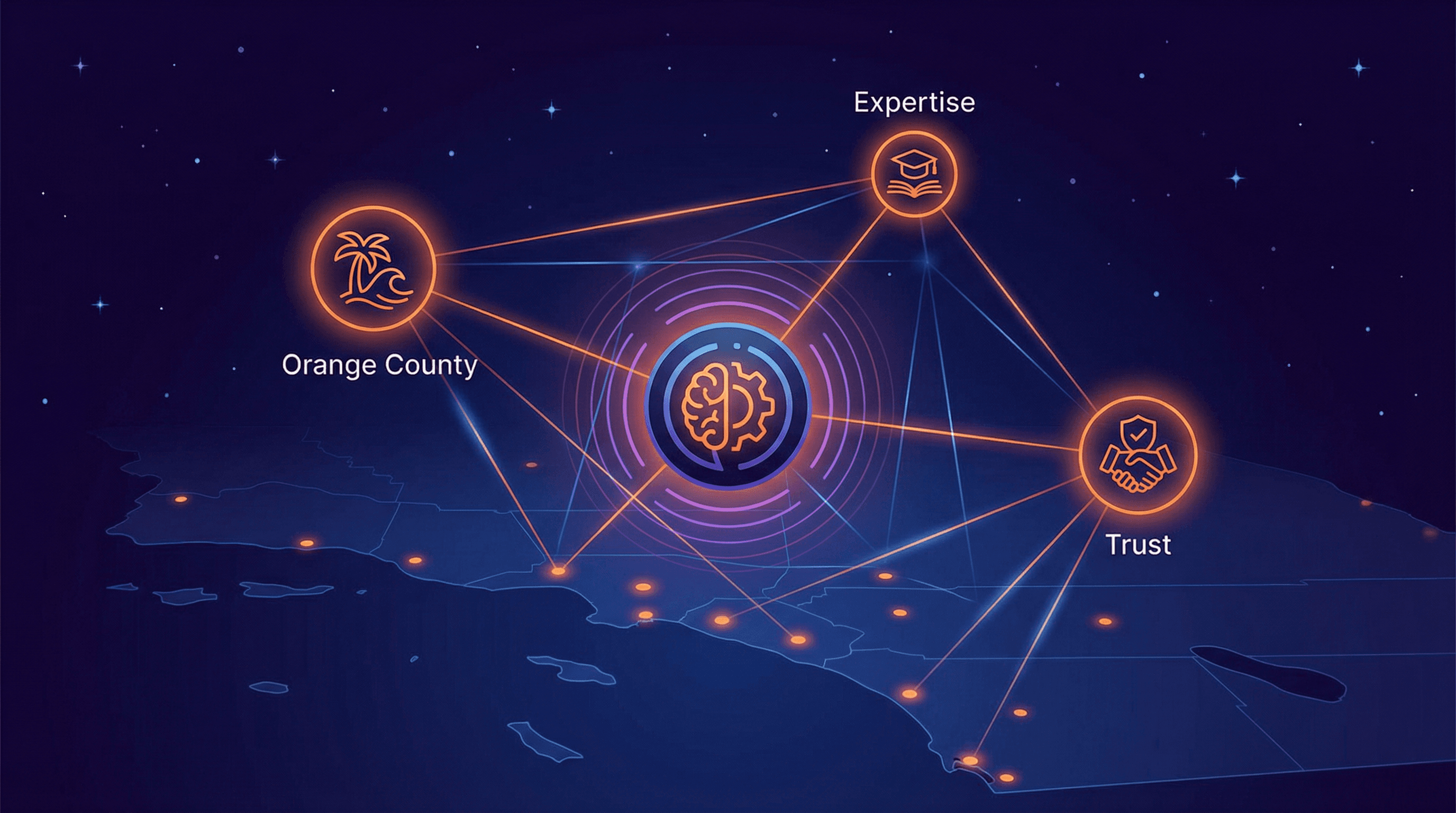
Illustration for AI Optimization Orange County: Beyond Traditional SEO
Now that we’ve established how to hand the AI a “cheat sheet” via RAG optimization and Schema markup, we need to talk about timing. Understanding the technical requirements is one thing; executing them before your competition does is where the actual revenue lies.
Right now, we’re looking at a unique market anomaly in Southern California. If you look at standard SEO metrics, Orange County is one of the most saturated markets in the world. However, if you shift your view to Generative Engine Optimization (GEO), the waters are calm, clear, and largely unoccupied. This is your Blue Ocean.
Competitive Landscape: Irvine, Newport Beach, and Beyond
If you’re running a law firm in Irvine, a plastic surgery clinic in Newport Beach, or a real estate brokerage in Laguna Niguel, you know the pain of traditional SEO. You’re likely fighting tooth and nail for the top three spots on Google, spending thousands a month on backlinks, guest posts, and 2,000-word blog articles just to maintain rank. Here’s the reality check: 99% of your competitors are still fighting that old war.
While they’re obsessing over Domain Authority (DA) and keyword density, they’re completely invisible to the large language models (LLMs) that are rapidly stealing search volume. Most businesses in the OC area have websites that are essentially “read-only” for humans but “unreadable” for AI. They lack the structured data, the entity relationships, and the concise context windows required for platforms like ChatGPT, Claude, or Google’s AI Overviews to recommend them.
This creates a massive disparity. You might have a competitor in Anaheim with a 20-year-old domain and thousands of backlinks who dominates Google Search. But to an AI, that competitor is just unstructured noise. By pivoting to AI optimization now, you aren’t just competing with them; you’re bypassing them entirely to speak directly to the user’s inquiry.
The First-Mover Advantage in AI Citations
In traditional SEO, rankings are volatile. You can be #1 today and #4 tomorrow because of a minor algorithm update. AI optimization works differently. It’s less about “ranking” and more about becoming a fundamental fact within the system.
We call this securing your place in the Southern California Knowledge Graph.
When an LLM answers a query like “who’s the most reliable commercial architect in Orange County?”, it relies on a web of entities and relationships it has verified as true. Once an AI model accepts a piece of information—for example, that Excelsior Creative is the authority on AI content in OC—it tends to hold onto that association. This is often referred to as “semantic permanence.”
Think of it like teaching a child a fact. Once they learn that the sky is blue, it takes a significant amount of contrary evidence to convince them otherwise.
By optimizing your digital footprint now, you’re essentially training the local AI models to recognize your brand as the “foundational truth” for your specific niche in Orange County. You’re embedding your business into the AI’s long-term memory. Competitors who wait another 12 to 18 months will find themselves trying to overwrite established data, which is infinitely harder and more expensive than establishing that data in the first place.
Case Study: The Cost of Waiting
To illustrate the stakes, let’s look at a hypothetical scenario based on real patterns we’re seeing in the luxury home service sector.
Consider two high-end HVAC companies in Huntington Beach: Company A and Company B.
Company A decides to invest in AI optimization in Q1 2024. They restructure their site for RAG, implement robust local Schema, and create concise, answer-based content. By Q3, when a user asks an AI agent, “Find me a verified HVAC tech in Huntington Beach that handles smart home integration,” the AI retrieves Company A’s data because it’s structured perfectly for the context window. The AI recommends them with a citation.
Company B sticks to traditional SEO. They write long, fluffy blogs about “The History of Air Conditioning.” They rank well on Google for generic terms, but when that same user asks the AI for a recommendation, the AI skips Company B because it can’t quickly parse whether they do “smart home integration.”
Fast forward to 2025. Company A is now the “incumbent” in the AI’s retrieval path. The AI has cited them thousands of times, reinforcing the connection between “Huntington Beach HVAC” and “Company A.”
When Company B finally realizes they’re losing market share and tries to pivot, they face a steep uphill battle. They aren’t just fighting for visibility; they’re fighting against the AI’s reinforced bias toward Company A. Company B now has to spend 5x the budget to displace the incumbent that Company A became simply by being first.
The window to become that incumbent in Orange County is open, but it’s closing fast. The businesses that define themselves to the machines today will own the answers of tomorrow.
Establishing Entity Authority: Beyond Keywords to Semantic Meaning
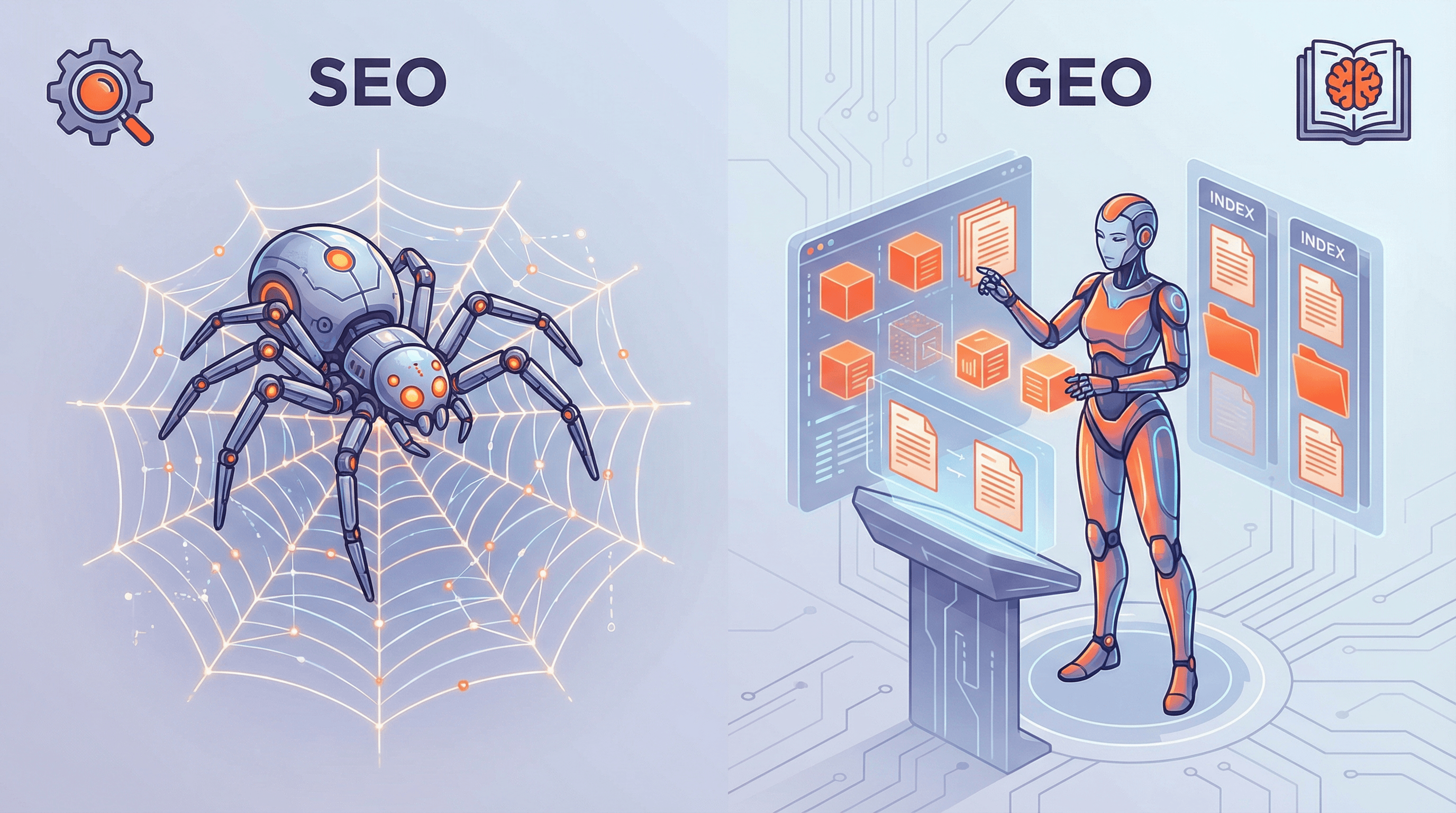
Illustration for AI Optimization Orange County: Beyond Traditional SEO
If Company A won the race in our previous scenario, it wasn’t because they stuffed the phrase “HVAC Huntington Beach” into their footer fifty times. It was because they fundamentally changed how they communicated with the machine. They stopped treating search engines like a card catalog and started treating AI agents like intelligent researchers.
To become the incumbent “Company A” in your niche, you’ve to move beyond keywords—which are just strings of text—and establish Entity Authority.
In the eyes of a Large Language Model (LLM) like GPT-4 or Gemini, your business isn’t a collection of keywords; it’s an “entity”—a distinct object with defined attributes and relationships to other objects. Traditional SEO was about matching a user’s search string to your text string. AI Optimization is about proving to the machine that your entity is the most logical, verified answer to a complex query. Here’s how you build that authority and define yourself to the machines.
Advanced Schema Markup for AI Discovery
For years, SEO professionals viewed Schema markup (structured data) primarily as a way to get “rich snippets”—those star ratings or event times—in Google search results. While that still matters, in the era of AI Search, Schema has taken on a much more critical role: it’s the native language of the AI agent.
When an AI agent crawls your site to answer a user’s question, it has to expend “compute” (processing power) to read your paragraphs and guess what you offer. This is inefficient. However, when you implement robust, nested JSON-LD (JavaScript Object Notation for Linked Data), you’re essentially handing the AI a cheat sheet.
You aren’t just telling the AI, “We do plumbing.” you’re providing a structured code block that explicitly defines:
- @type: ProfessionalService
- areaServed: Orange County (defined by specific GeoCoordinates)
- knowsAbout: PEX repiping, Slab leak detection, Tankless water heaters
For an Orange County business, basic Schema isn’t enough. You need to implement nested schemas that AI agents can actually parse for context. For example, instead of just listing your services, your Schema should link your “Service” entity to a “Review” entity and a “Location” entity.
When the AI sees this clean, structured data, it lowers the “confidence threshold” required to cite you. It doesn’t have to guess if you serve Laguna Niguel; your code explicitly states it in a format the AI trusts more than marketing copy.
Building a Knowledge Graph for Your OC Brand
Once the AI understands what you’re, it needs to understand where you fit in the real world. This is where building a Knowledge Graph comes into play.
A Knowledge Graph represents a network of real-world entities—objects, events, situations, or concepts—and illustrates the relationship between them. For a local business, this means connecting your brand entity to established local entities to borrow their geographic authority.
If you’re a luxury real estate agent in Newport Beach, you shouldn’t just write “Newport Beach” on your landing page. You need to semantically connect your business to the landmarks that define the area.
In your content and structured data, you want to create “triples” (Subject-Predicate-Object connections). For example:
- Subject: [Your Brand]
- Predicate: is located near
- Object: [Fashion Island]
- Subject: [Your Brand]
- Predicate: specializes in architecture styles found in
- Object: [Crystal Cove Historic District]
By explicitly connecting your business to verifiable Orange County landmarks—whether that’s Angel Stadium, the Mission San Juan Capistrano, or the Irvine Spectrum—you anchor your entity in a specific geographic reality.
Why does this matter for AI? Because when a user asks, “who’s the best architect for a historic renovation near San Juan Capistrano?”, the AI looks for vector proximity. If your brand entity is already semantically linked to the “Mission San Juan Capistrano” entity in the AI’s training data (or your site’s RAG retrieval path), you become the statistically probable answer. You aren’t just a website; you’re part of the local fabric.
Topic Clusters vs. Keyword Lists
Finally, establishing entity authority requires a shift in editorial strategy. We need to move away from linear keyword lists and toward Topic Clusters that answer “The Why.”
Traditional SEO (Company B strategy) involves finding a keyword like “Estate Planning Attorney Irvine” and writing 1,000 words that repeat that phrase.
AI Optimization (Company A strategy) involves understanding that “Estate Planning” is a topic cluster containing hundreds of related concepts, questions, and intent vectors.
To capture AI traffic, you must create content that answers “The Why” rather than just “The What.” AI users are asking increasingly complex questions. They aren’t searching for “Lawyer Irvine.” they’re asking, “My father owns a small business in Santa Ana and is retiring; what are the tax implications of transferring ownership to me versus selling?”
A generic “what’s Estate Planning” blog post fails here. To win, you need a cluster of content that addresses the nuances of Orange County business succession, California specific tax codes, and family trust dynamics.
This approach signals “Topical Authority.” When an LLM analyzes your site, it shouldn’t see a flat list of keywords. It should see a 3D web of interconnected expertise. By covering the nuance—explaining why coastal humidity affects wood flooring in Dana Point differently than dry heat in Yorba Linda—you provide the high-context tokens that LLMs crave.
When your content creates this depth, the AI assigns your entity a higher “trust score” for that specific topic. You become the expert not because you said you’re, but because your content map covers the subject more thoroughly than the competition.
Dominating the LLM Context Window: Citations and Mentions
Additional infographic for AI Optimization Orange County: Beyond Traditional SEO
Once you’ve established deep topical authority on your own website—proving you understand the difference between wood flooring in Dana Point versus Yorba Linda—you face the next hurdle: corroboration.
In the old world of SEO, you needed backlinks. A link was a vote. In the new world of Large Language Models (LLMs) and Generative Engine Optimization (GEO), you need citations and mentions.
Think of the LLM as a court of law. Your website’s content is your testimony. It’s detailed, accurate and convincing. However, the judge (the AI) is skeptical. It needs witnesses. It needs external validation to confirm that what you say about your expertise is true. If your site is the only place on the internet claiming you’re the “best tax attorney in Irvine,” the AI treats that as a self-proclaimed bias. But if the Orange County Register and the Irvine Chamber of Commerce also mention your firm in the context of tax law, the probability of your brand being the correct answer skyrockets.
This is where we move from managing keywords to dominating the context window.
Digital PR in the Age of Generative AI
Traditional PR was about getting exposure; AI-focused Digital PR is about building semantic associations. When ChatGPT or Gemini processes a query, it’s predicting the next likely token based on the vast amount of text it has been trained on. You want your brand to be statistically inseparable from your service and your location.
This requires a shift in how we view media coverage. It’s no longer enough to simply get a link. We must focus on Sentiment Analysis.
LLMs are incredibly adept at understanding the emotional tone and context surrounding a brand mention. If a local blog mentions your business, the adjectives surrounding your name matter immensely.
- Old SEO: A link from a high-domain authority site is good, regardless of context.
- AI Optimization: A mention in a paragraph describing your brand as “reliable,” “responsive,” and “expert” is gold.
If the prevailing sentiment around your brand in public forums, reviews and articles is “affordable but slow,” the AI will pigeonhole you. When a user prompts, “who’s a premium, white-glove service provider in Newport Beach?” you won’t make the cut—even if you’ve the right keywords on your site. To increase your “Share of Model”—the frequency with which an AI recommends your brand over competitors—you must aggregate positive, descriptive citations that reinforce the specific attributes you want to be known for.
Influencing the Training Data via Local Authority Sites
To get into the “consideration set” of an AI, you need to appear in the sources the AI trusts most. Not all websites are weighted equally in training data. High-authority news outlets, educational institutions, and established industry journals carry significantly more weight than a generic blog or a press release wire service.
For a business in our region, securing mentions in publications like the OC Register, Orange Coast Magazine, or even hyper-local papers like the Laguna Beach Independent is critical.
Why? Because LLMs treat these editorial sources as “ground truth.”
Let’s go back to the estate planning example. If you can secure a quote in an OC Register article discussing “The impact of Prop 19 on Orange County heirs,” you’ve achieved two things:
- Entity Association: you’ve physically placed your brand name next to the topic “Prop 19” and the location “Orange County” in a high-trust environment.
- Expert Validation: The journalist selected you as the expert. The AI interprets this as a strong signal of authority.
This isn’t about spamming journalists with press releases. It’s about being the go-to source for local nuance. When you provide value to these publications, you’re effectively writing yourself into the training data of future model updates.
The Power of Niche Orange County Directories
While high-level PR provides the prestige, niche directories provide the structure. LLMs rely heavily on structured data to understand “Entities”—real-world things like businesses, people, and places.
You might think directories are a relic of 2010, but in the context of AI, they’re the scaffolding of your digital identity. However, we aren’t talking about generic, national directories. We’re talking about the local knowledge graph.
An LLM looks for consistency. It scans the Irvine Chamber of Commerce, specific industry associations (like the OC Bar Association), and local business leagues. When it sees your Name, Address and Phone number (NAP) aligned perfectly across these trusted local nodes, its confidence score in your existence and location increases.
But here’s the nuance: Category specificity is key.
If you’re a customized home builder, being listed in a general “California Business Directory” is fine, but being listed in a “Coastal California Architects & Builders” guild is exponentially better. The latter provides context. It tells the AI, “This entity belongs to this specific cluster of concepts.”
By layering these three elements—sentiment-rich Digital PR, high-authority local news mentions and structured niche directories—you create a web of external validation. You’re no longer just telling the AI you’re the best; you’re proving that the rest of Orange County agrees with you.
The AI Optimization Roadmap for Orange County Firms
Once you’ve established that external web of validation through local PR and niche directories, the foundation is set. You’ve proven to the algorithms that you exist, you’re located in Orange County and you’re legitimate. Now, we’ve to pivot from existence to preference.
It’s one thing for an AI to know you’re a logistics company in Anaheim; it’s entirely another for it to recommend you as the “most reliable” option when a user asks for a vendor.
Transitioning from traditional SEO to AI Optimization (AIO) isn’t just about tweaking meta tags or buying backlinks. It requires a fundamental shift in how you architect your digital presence. You need a roadmap that moves you away from chasing the Google algorithm and toward satisfying the “reasoning engines” of ChatGPT, Claude and Gemini.
Auditing Your Current AI Visibility
In the old days of SEO, auditing was straightforward. You plugged your URL into a tool like Semrush or Ahrefs, and it spat out a list of broken links and keyword rankings. AI is different. There is no dashboard that tells you exactly how a Large Language Model (LLM) “feels” about your brand. The index is a black box.
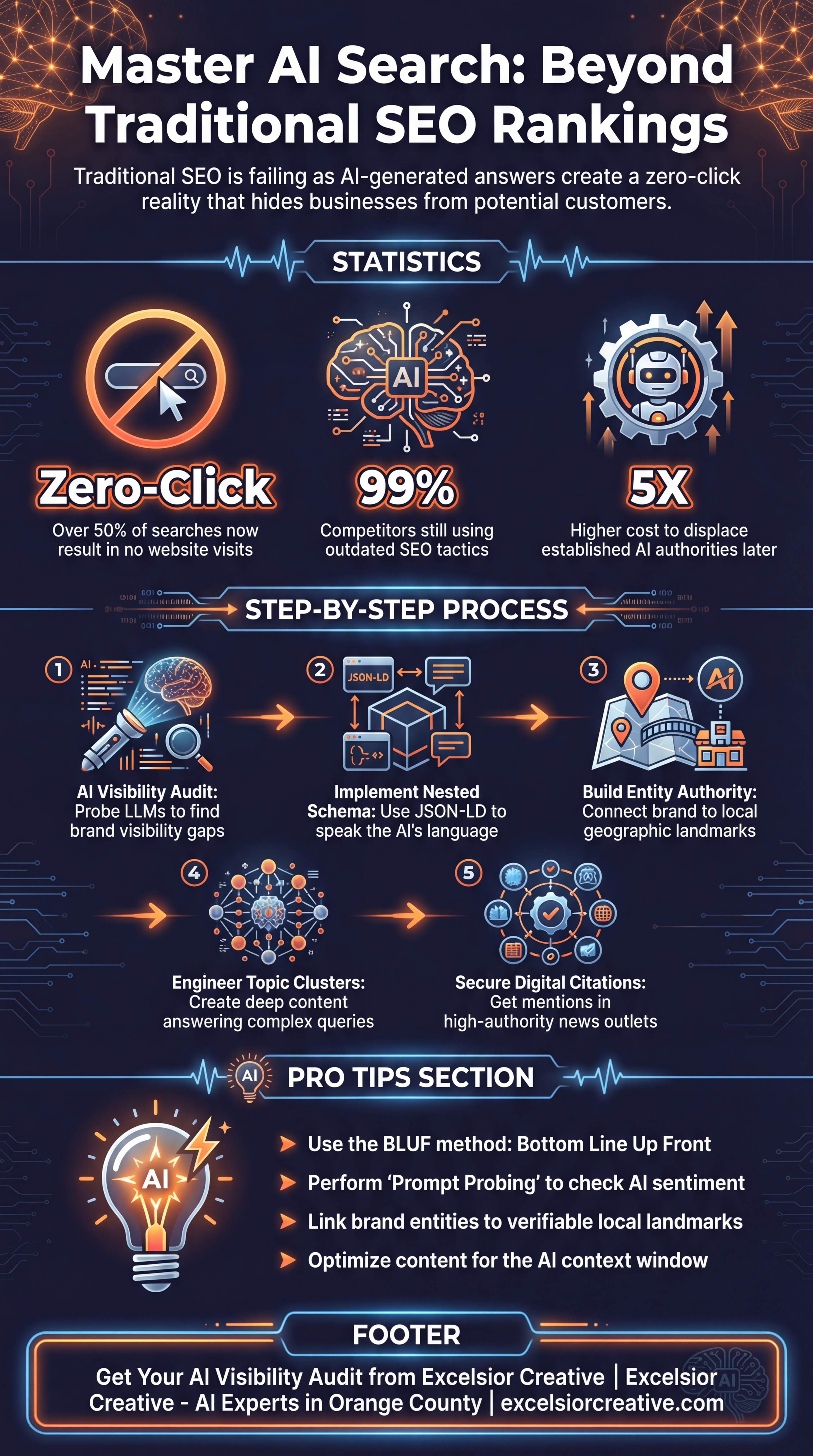
To understand your standing, you’ve to interrogate the models directly. We call this “Prompt Probing.” You need to simulate the queries your potential clients are asking and analyze the output not just for rankings, but for context. Here’s a practical checklist to transition your audit process from SEO to AIO:
The AIO Transition Checklist:
- The Unbranded Discovery Test: Open ChatGPT, Perplexity and Gemini. Ask a generic query relevant to your OC sector without naming yourself. For example: “Who are the top three commercial interior designers in Irvine for tech startups?” Note who the AI recommends. If you aren’t there, analyze the profiles of the three firms that are. What specific attributes does the AI cite? (e.g., “known for sustainable materials,” “award-winning”). These are the entity associations you’re missing.
- The Hallucination Check: Ask the AI specifically about your brand. “Tell me about [Your Company Name] in Orange County.” Does it get your location right? Does it invent services you don’t offer? Hallucinations usually happen when there is a data void. If the AI is making things up, it means your structured data (schema markup) is weak or contradictory across the web.
- The Sentiment Analysis: Ask the AI to compare you to a competitor. “Compare the services of [Your Firm] and [Competitor Firm] for a project in Huntington Beach.” This reveals the model’s bias. Does it view you as the “budget option” or the “premium choice”? This feedback loop is critical for adjusting your brand messaging.
- The Knowledge Cutoff Audit: Check if the AI is referencing outdated achievements. If it mentions an award you won in 2019 but misses your 2024 expansion, your recent digital PR hasn’t penetrated the training data or the retrieval-augmented generation (RAG) layers yet.
Content Engineering for Generative Engines
Once you know where the gaps are, you’ve to fill them. But you can’t simply write more blog posts. You’ve to write differently.
For the last decade, we’ve been trained to write 2,000-word articles to keep users on the page longer (dwell time). However, LLMs don’t “dwell.” They scrape, process, and synthesize. If your value proposition is buried in paragraph four behind a wall of fluff, the AI might miss the connection entirely.
We need to adopt a dual-layer writing strategy: Writing for the Human and the Scraper simultaneously.
To do this, structure your content using “Entity-Rich” formatting. LLMs love structure. They digest bullet points, data tables and direct answers much faster than long-form prose.
- The “BLUF” Method (Bottom Line Up Front): Don’t bury the lead. Start every section with a direct, factual answer that an AI can easily extract and serve as a snippet. Follow that with the nuance and storytelling that human readers enjoy.
- Semantic Closeness: Ensure your content physically places your brand name next to the keywords and entities you want to own. Instead of saying “We offer great services,” say “Excelsior Creative provides enterprise branding for Orange County fintech firms.” you’re spoon-feeding the relationship to the bot.
- FAQ Engineering: Move beyond generic FAQs. Create questions that mirror natural language voice queries. “what’s the cost of commercial solar installation in Santa Ana?” Answer with specific data ranges. This increases the probability of your answer being the source material for a generative response.
Measuring Success: New KPIs for the AI Era
Perhaps the most difficult part of this roadmap is explaining the results to stakeholders. The C-Suite is used to hearing “we’re #1 on Google.” In the AI era, rankings are fluid and personalized. There is no singular “Page 1.”
We need to retire the obsession with rank and focus on two new, more potent metrics: Citation Share and Brand Sentiment.
Citation Share (Share of Model)
This is the new market share. If an LLM answers a query about “Top OC Estate Planning Attorneys” 100 times, how many times is your firm mentioned in the answer? If you appear in 40 of those responses, you’ve a 40% Citation Share. Tracking this requires consistent prompt probing over time, but it’s a far more accurate predictor of lead generation than a static keyword ranking.
Brand Sentiment Score
it’s possible to be mentioned frequently but negatively (or neutrally). You want the AI to advocate for you. We measure this by analyzing the adjectives the AI uses when describing your brand. Is it using words like “leading,” “trusted,” and “innovative”? Or is it using “standard,” “available,” or “local”?
Moving the needle from “available” to “trusted” requires the strategy we discussed earlier: high-quality digital PR and niche directory associations that reinforce your authority.
By focusing on these metrics, you stop playing the game of “tricking” a search engine and start playing the game of Brand Authority. In Orange County’s competitive landscape, you don’t just want to be found; you want to be the answer the AI feels confident giving.
The Future of Search: Staying Ahead of AI Evolution
Once you’ve shifted your mindset from chasing rankings to building Brand Authority and Citation Share, you’re already miles ahead of most competitors in Orange County. But the landscape isn’t static. While we’re currently focused on how Large Language Models (LLMs) like ChatGPT and Claude interpret your business, the medium through which people access this information is undergoing a radical hardware shift. We’re moving toward a world where the search bar itself might become obsolete.
Voice Search Integration and Personal AI Agents
For years, we’ve talked about voice search regarding Siri or Alexa, but the next wave is fundamentally different. We’re entering the era of the “Large Action Model” (LAM).
Devices like the Rabbit R1, the Humane AI Pin, and the inevitable deep integration of AI into Apple’s ecosystem are designed to do more than just retrieve information; they’re designed to take action. When a user in Newport Beach speaks to their AI agent, they won’t say, “Show me a list of top-rated landscapers.” they’ll say, “Find a landscaper who specializes in drought-tolerant designs and book an appointment for Tuesday.”
In this scenario, there is no “Page 1.” There is only the single, best solution the AI trusts enough to execute a transaction with.
To prepare for this hardware evolution, your digital infrastructure needs to be machine-readable. This goes beyond basic schema markup. It means ensuring your booking engines, pricing structures, and service availability are transparent and accessible to these agents. If an AI agent hits a friction point on your website—like a clunky contact form or a PDF menu—it will bypass you for a competitor that offers a seamless digital handshake.
The Convergence of Social Media and AI Search
We also can’t ignore where the AI models are getting their real-time context: social media.
You may have noticed that for younger demographics, TikTok and Instagram have effectively replaced Google Search. What’s less discussed is how this behavior feeds back into AI optimization. LLMs are increasingly being trained on, or having real-time access to, social data to gauge relevance.
Google’s search generative experience and other models are beginning to index short-form video content to answer queries. If someone asks an AI about the “best atmosphere for a business lunch in Irvine,” the AI isn’t just looking at Yelp reviews anymore. It’s cross-referencing sentiment found in user-generated content on TikTok and Instagram Reels.
If your brand is silent on these platforms, you’re creating a data void. You don’t need to be a viral sensation, but you do need a presence that confirms your vibrancy. When the AI sees consistent, positive social signals, it reinforces that “Trusted” Brand Sentiment score we discussed earlier. It signals to the algorithm that your business is active, culturally relevant, and currently operational.
Final Thoughts: Winning the Orange County Market
we’re currently looking at a massive “Blue Ocean” opportunity.
The vast majority of businesses in Orange County are still pouring their budgets into traditional SEO—fighting tooth and nail for ten blue links on a screen that’s slowly losing relevance. They’re optimizing for 2019.
By pivoting to AI Optimization (AIO), you’re bypassing that crowded, bloody water entirely. You’re positioning your brand to be the default answer for the next generation of search technology. This is about ensuring that when a potential client asks a question—whether they type it into Perplexity, speak it to a Rabbit R1, or search for it on a social platform—your business is the only logical recommendation.
The window to establish this early authority is open, but it won’t stay open forever. As the models mature, the “trusted” list will calcify. The time to train the AI on your value is now.
*
Is your brand ready for the AI era?
At Excelsior Creative, we don’t just write content; we architect digital authority. If you’re ready to stop chasing algorithms and start influencing the AI models that drive decision-making, let’s talk.
Contact us today for an AI Visibility Audit and let’s secure your place in the future of search.