

The Hidden Cost of Tradition: Why Orange County Businesses are Overpaying for Social Media
If you’ve ever reviewed a proposal from a legacy marketing firm in Orange County, you’ve likely experienced sticker shock. The retainers often start at five figures, and while the promise of “full-service” management sounds comforting, the math rarely adds up when you look at the actual output. For years, businesses have accepted these costs as the price of doing business in a premium market. But the reality is that the traditional agency model is built on an infrastructure that no longer serves the client’s bottom line, especially when it comes to social media.
The uncomfortable truth is that you aren’t just paying for strategy and creative execution. You’re paying for a business model that hasn’t updated its operating system since the early days of Facebook.
The High-Rent Agency Illusion in Irvine and Newport Beach
Let’s be honest about where your marketing dollars are actually going. When you hire a prestigious agency with a shiny address on Jamboree Road in Irvine or overlooking the harbor in Newport Beach, you’re inadvertently funding their overhead.
Those floor-to-ceiling glass conference rooms, the imported espresso machine in the lobby and the prime real estate near Fashion Island aren’t free. Traditional agencies bake these operational costs into their client retainers. We call this the “Agency Tax.” It’s the premium you pay not for better tweet performance or higher engagement rates on LinkedIn, but for the agency to maintain the appearance of prestige.
For a long time, this was the only option. If you wanted top-tier talent, you had to hire the agency with the high rent because that’s where the talent worked. But the landscape has shifted. The overhead-heavy model forces agencies to charge for hours rather than outcomes. They’ve to justify the headcount and the square footage, which means you end up paying $250 an hour for a junior associate to manually resize images or schedule posts, tasks that offer zero strategic value but keep the billable hours ticking upward.
The Transition from Manual Labor to Algorithmic Precision
Beyond the financial bloat of physical overhead, the traditional workflow of content creation is simply too slow for the modern feed.
Consider the standard agency approval loop: A strategist brainstorms a concept, a copywriter drafts the caption, a designer builds the asset, an account manager reviews it and then it finally lands in your inbox for approval. This process can take anywhere from three days to two weeks. In 2015, that timeline was acceptable. Today, a TikTok trend lives and dies in 48 hours. By the time a traditional agency pushes a piece of content through its manual bureaucratic pipeline, the cultural moment has already passed.
This inefficiency is why we are seeing a massive shift in how local businesses approach their digital presence. Savvy marketing directors are realizing that paying humans to do robotic work is a waste of budget. They’re tired of the bottleneck.
This is where the pivot happens. We are seeing a surge in search volume for ‘AI Social Media Marketing Orange County’ because CMOs are looking for a way out of the high-cost, low-speed trap. They want the strategy to be human, but the execution to be algorithmic.
Transitioning to AI-driven social media doesn’t mean removing the human touch; it means removing the human drag. It allows for the rapid analysis of data to see what’s working, the instant generation of variations to test messaging, and the ability to scale content production without scaling costs linearly. You stop paying for the Newport Beach view and start paying for actual market penetration.
The Agency Tax: Breaking Down the Inefficiencies of Traditional Social Media Management
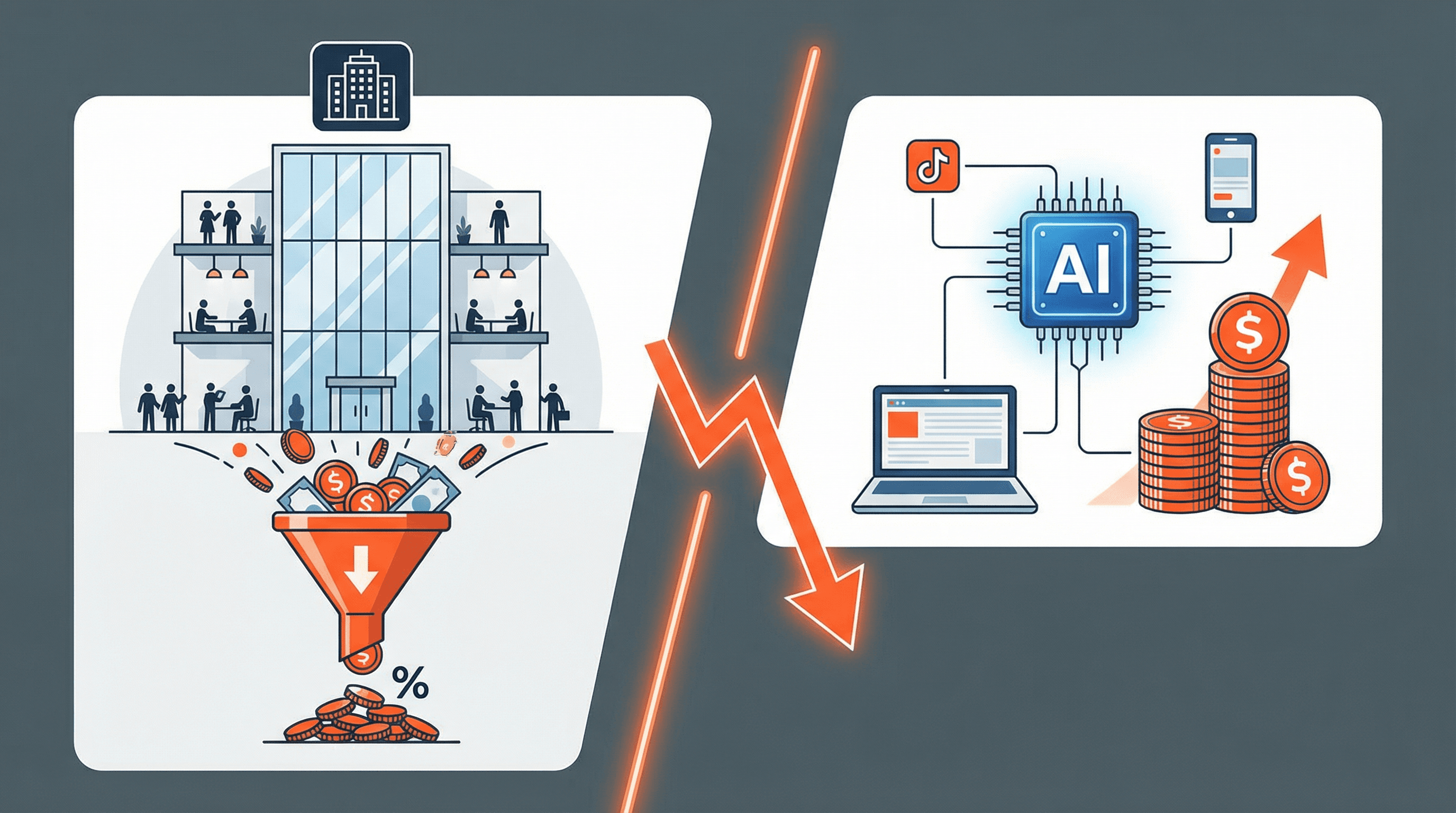
Illustration for AI Social Media in Orange County: Why You're Overpaying
That “human drag” we just discussed doesn’t just slow down your feed, it drains your P&L. In the industry, we call this “The Agency Tax.” it’s the premium you pay not for better performance or higher conversion rates, but to subsidize an operational model that hasn’t fundamentally changed since the era of print ads, even though the tools at our disposal have evolved exponentially.
When you hire a traditional agency in Orange County, you aren’t just buying social media posts; you’re buying their overhead, their inefficiencies, and their reluctance to automate. You’re paying for the comfort of a familiar process, even if that process is mathematically designed to waste your budget. To understand why the pivot to AI is financial prudence rather than just a tech trend, we have to audit where that money is actually going.
The Bloated Staffing Problem
If you look under the hood of a standard $5,000 to $10,000 monthly social media retainer, you’ll find a hierarchy that’s redundant in 2024. The traditional agency model relies on billing you for a stack of humans touching every single deliverable.
Usually, the lineup looks something like this:
- The Account Manager: Often functions as a highly paid email forwarder, relaying your feedback to the creative team.
- The Strategist: Sets the high-level direction (often only once a quarter).
- The Senior Copywriter: Drafts the captions and overlay text.
- The Junior Designer: Resizes images and applies templates.
- The Creative Director: Glances at the work for five minutes before it goes to the Account Manager. You’re paying an hourly rate for every single one of these people to interact with your content. But let’s be honest: does a human need to bill you $150 an hour to resize a graphic for Instagram Stories? Does a Senior Copywriter need to bill two hours to draft five variations of a hook?
This is where the Agency Tax hits hardest. AI tools can now generate fifty design variations in the time it takes a junior designer to open Photoshop. Large Language Models (LLMs) can draft twenty caption options based on your specific brand voice in seconds. When you stick to the traditional model, you’re paying for manual labor in an era of automation. You’re paying for the effort it takes to create the content, rather than the impact of the content itself.
The 30-Day Content Lag
Beyond the staffing costs, the traditional model imposes a “time tax” that’s equally damaging. Most agencies operate on a 30-day content calendar. They present you with a grid of posts for next month on the 25th of the current month. It feels organized. It feels safe. You sign off on it, and everyone relaxes.
But social media algorithms don’t care about your safety or your organizational skills. They care about relevance.
The 30-day lag completely kills your ability to engage in trend-jacking. If a specific audio clip trends on TikTok on a Tuesday, it will likely peak by Thursday and be “cringe” by the following Monday. In a traditional agency workflow, spotting that trend, briefing the team, creating the asset, routing it through the Creative Director, sending it to you for approval, and scheduling it takes a week minimum. By the time your brand participates, the cultural moment has passed. You end up looking like a corporate entity trying too hard to fit in, rather than a culturally aware brand.
Activity vs. Results
Ultimately, the Agency Tax stems from a confusion between paying for activity and paying for results.
Traditional retainers are sold on deliverables: “we’ll provide 3 posts per week and 5 stories.” The agency’s goal is to check those boxes so they can send the invoice. If they post three times and engagement is flat, they’ve still fulfilled their contract. They sold you the activity of posting.
An AI-integrated approach flips this dynamic. Because the cost of production (the “activity”) drops to near zero, the focus shifts entirely to the outcome. You aren’t paying for the hours it took to write the post; you’re investing in the intelligence required to analyze why one post worked and another didn’t, and the ability to iterate instantly. You stop paying for the bloated staff meeting in an Irvine boardroom and start paying for market penetration.
The Disruptors: How Nano Banana Pro and Pomelli Are Rewriting the Rules
If we accept that the traditional agency model is selling you expensive activity rather than tangible results, the natural question becomes: What replaces it? It’s not enough to simply fire your agency and hope your internal marketing manager can pick up the slack without burning out. You need a structural shift in how work gets done.
This is where the conversation moves from abstract “AI adoption” to specific, tactical tools that are currently dismantling the agency stronghold in Orange County. We aren’t talking about generic use cases for ChatGPT. We are looking at specialized platforms like Nano Banana Pro and Pomelli, tools designed to automate the heavy lifting that agencies used to charge five figures a month to manage.
Nano Banana Pro: High-Volume Engagement at Scale
For years, “Community Management” has been a line item on agency invoices that’s notoriously difficult to audit. Usually, it involves a junior employee manually scrolling through hashtags, leaving generic comments like “Great shot! 🔥” or replying to DMs with copy-pasted templates. It’s low-skill, high-labor work.
However, in the algorithmic era, engagement is currency. You can’t grow a brand in a saturated market like Newport Beach or Irvine simply by posting; you’ve to interact. You need to be seen in the comments sections of local influencers, complementary businesses, and potential customers.
Nano Banana Pro has effectively rendered the manual community manager obsolete. It doesn’t just “bot” comments; it utilizes advanced vision and language models to analyze the context of a post before interacting. If a local lifestyle influencer posts a photo of a brunch spot in Costa Mesa, Nano Banana Pro doesn’t just drop an emoji. It recognizes the food, reads the caption about the “Sunday scaries,” and generates a relevant, witty, or supportive comment that sounds indistinguishable from a human user.
The impact on your P&L is immediate. Instead of paying a salary (or an agency fee) for a human to engage with 50 comments a day, this tool allows a single marketing director to oversee engagement on 500 to 1,000 posts daily. It creates a massive “surface area of luck” for your brand, increasing visibility across the platform without requiring a single hour of overtime. It turns community management from a bottleneck into a scalable, always-on growth engine.
Pomelli: The New Standard for Hyper-Localized Content
While Nano Banana Pro handles the outbound engagement, Pomelli solves the production bottleneck. As we discussed regarding the “30-day lag,” the biggest hurdle in localized marketing is the time it takes to create assets that feel authentic to the area.
Generic AI tools often fail here. Ask Midjourney for a “luxury home in Orange County,” and you might get something that looks like Miami or the Mediterranean. It lacks the nuance of our topography, our lighting, and our specific architectural vernacular.
Pomelli has emerged as the disruptor here because it’s built for localized context. It allows brands to generate OC-specific content in seconds rather than hours. Let’s say you’re a real estate firm or a lifestyle brand and a sudden heatwave hits in October, a classic Santa Ana wind event.
In the old workflow, you would brief the agency. They would look for stock footage or schedule a shoot. A designer would mock up the graphics. By the time the post goes live, the weather has cooled down.
With Pomelli, your internal team can generate high-fidelity imagery of specific local aesthetics, the dust kicking up off the trails in Crystal Cove or the specific golden hour light hitting the 405 and overlay brand-compliant copy instantly. You move from ideation to publication in under ten minutes. This capability allows your brand to feel like a living, breathing part of the community that reacts to local events in real-time, rather than a corporate entity scheduling posts from a content calendar created three weeks ago.
The New Workflow: Integrating AI Without the Headcount
The arrival of these tools signals a massive shift in how marketing departments operate. We are seeing a move toward “in-housing without the headcount.”
Previously, bringing social media in-house meant hiring a photographer, a copywriter, a strategist, and a community manager. That’s a $300,000+ payroll liability. Now, a single competent Marketing Director, armed with Nano Banana Pro for engagement and Pomelli for creation, can outproduce a five-person agency team.
This integration of AI-driven workflows means your existing marketing department stops being project managers who spend their days approving agency work. They become the creators and the executors. The friction is removed. The “Agency Tax” is eliminated. You’re no longer paying for the time it takes to do the work; you’re simply paying a subscription for the intelligence to get it done instantly.
AI Social Media Marketing Orange County: A Side-by-Side Cost Analysis
That phrase, the “Agency Tax”, isn’t just a clever turn of phrase; it’s a quantifiable line item that has likely been dragging down your marketing budget for years. When we talk about shifting from a traditional agency model to an AI-enhanced internal workflow, we aren’t talking about shaving off a few percentage points of overhead. We are looking at a fundamental restructuring of your P&L.
To understand why Excelsior Creative and other forward-thinking firms are advocating for this shift, we have to look at the hard numbers. We need to strip away the buzzwords and look at the invoices.
The $5,000 Retainer vs. The AI-Enhanced Workflow
In the Orange County market, whether you’re based in the tech hubs of Irvine or the lifestyle centers of Newport Beach, a standard social media retainer for a reputable boutique agency starts around $5,000 per month.
What does that $5,000 actually buy you? In a traditional model, that retainer usually covers:
- 12 to 15 static posts (Instagram/LinkedIn)
- 4 to 8 stories
- Community management (responding to comments)
- One monthly reporting call
When you break it down, you’re paying roughly $300 to $400 per piece of content. The bulk of that cost isn’t the creative work itself; it’s the account management, the back-and-forth emails, the internal agency meetings and the overhead of their office space.
Now, let’s look at the AI-enhanced workflow using the tools we mentioned earlier, like Pomelli and Nano Banana Pro.
The Tech Stack Cost:
- Generative Visual Suite (e.g., Pomelli): ~$150/month (Enterprise tier)
- AI Copy & Strategy Assistant: ~$50/month
- scheduling & Analytics: ~$100/month
- Total Monthly Tech Spend: ~$300
The Human Capital Cost:
Even the best AI requires a human pilot. However, because the ideation and creation phases are accelerated, your internal Marketing Director needs only about 5 hours a month to generate, review and schedule that same volume of content. If we value that time at a generous $100/hour, that’s $500 in labor.
The Total: $800/month.
The Result: you’ve effectively moved from a $5,000 monthly spend to an $800 spend for the exact same output. That’s an 84% reduction in monthly social media spend. Even if you double the labor hours for extra scrutiny, you’re still looking at a consistent 60-80% savings. That isn’t found money; that’s capital you can reallocate toward paid ad spend to actually distribute the content you’re creating.
Calculating ROI on Tech Subscriptions vs. Human Capital
Cost reduction is attractive, but the real story here is output efficiency. In the digital economy, whoever produces the most high-quality volume usually wins. Algorithms feed on consistency and frequency.
In the agency model, if you want to move from 15 posts a month to 75 posts a month to aggressively capture market share, your costs rise linearly. A 5x increase in output generally results in a 5x increase in fees. Your $5,000 retainer becomes a $25,000 monthly liability.
With an AI-driven workflow, the math changes entirely.
Output Volume Comparison:
- Traditional Workflow: 1 hour = 1 piece of polished content (copy, design, approval).
- AI-Driven Workflow: 1 hour = 10+ pieces of polished content (batch creation, variant generation, instant resizing).
Because the software subscriptions are fixed costs, increasing your volume doesn’t increase your tech spend. You can produce 5x more content for 1/4 of the cost of your previous agency retainer. You’re no longer rationing posts because of budget constraints. You can flood the feed with localized, high-fidelity content without triggering an overage fee.
The Scalability Factor
Finally, consider the “success penalty” inherent in human-heavy services. As your brand grows, as you gain followers and engagement increases, agencies often restructure contracts. They argue that managing a community of 100,000 requires significantly more resources than managing a community of 10,000. And they aren’t wrong; for humans, it does.
AI, however, is agnostic to your follower count. It takes the same amount of computing power to analyze sentiment on 50 comments as it does on 5,000.
This is the scalability factor that CFOs love. Your marketing costs become predictable and flat, regardless of your viral success. You don’t get punished for growing. Instead of your margins shrinking as you scale because you’ve to hire more bodies to manage the noise, your margins actually improve. The software absorbs the volume, and your team remains lean, focused on strategy rather than churning out replies.
This financial reality is why the old retainer model is dying. It simply can’t compete with a workflow that offers five times the use for a fraction of the price.
Beyond the Bot: Achieving High-Touch Quality with AI-Driven Workflows
But let’s address the elephant in the room. When most executives hear “automation” and “cost reduction” in the same sentence, they instinctively worry about a drop in quality. There is a fear that by pivoting to AI, your brand will start sounding like a generic customer service chatbot, polite, functional, but utterly soulless.
In a market like Orange County, where image is currency and authenticity is scrutinized, that risk feels amplified. However, the reality of modern AI deployment is exactly the opposite. When you stop paying humans to do robotic tasks (like resizing images or drafting hashtags), you free them up to do what humans do best: be creative, strategic, and culturally aware.
Maintaining the ‘Orange County’ Brand Voice
The misconception is that AI writes in a vacuum. The truth is that AI writes based on the parameters you set. If you feed a model generic prompts, you get generic results. But when you use advanced platforms like Pomelli, you aren’t just generating text; you’re building a digital twin of your brand’s persona.
This is where the distinction between “robotic” and “high-fidelity” lies. A standard tool might describe a sunset in Newport Beach as “beautiful.” A properly tuned AI workflow, customized for local cultural nuances, understands the difference between the laid-back surf culture of Huntington and the polished, coastal luxury of Crystal Cove.
We customize these models to understand the ‘OC’ vernacular. It’s about training the system to recognize that a post targeting Irvine tech professionals requires a different cadence than a post aimed at Laguna Beach art collectors. By ingesting your brand’s historical data and successful posts, the AI learns your specific syntax, humor, and vocabulary. It doesn’t replace your voice; it amplifies it, ensuring that whether you post five times a week or fifty, the tone remains unmistakably yours.
The Human-in-the-Loop Strategy
So, where does the human fit in? This shift in technology necessitates a shift in job titles. We are moving away from the “Social Media Manager”, someone who spends hours writing captions and scheduling posts, toward the “AI Strategist.”
The AI Strategist isn’t a bricklayer; they’re the architect. In this workflow, the AI generates the raw materials, three variations of a caption, five different visual crops and a dozen hashtag clusters. The Strategist’s role is to curate. They apply the “human-in-the-loop” methodology, reviewing the AI’s output to ensure it hits the emotional mark.
This approach is vital for brand safety. While AI is excellent at pattern recognition, it can sometimes miss context. A human eye ensures that a generated post doesn’t inadvertently clash with a breaking local news story or misuse a trending audio clip. The Strategist acts as the final quality gatekeeper, polishing the diamond rather than digging it out of the rough.
By combining the raw horsepower of AI with the nuanced taste of a human strategist, you achieve a level of “high-touch” quality that manual workflows simply can’t sustain at scale. You get the volume of a machine with the soul of a local.
Local Success Stories: From Laguna Beach to Brea
But theory only gets you so far. The concept of the “AI Strategist” might sound like future-proofing, but for savvy business owners across Orange County, it’s already the present reality. We aren’t talking about hypothetical scenarios in Silicon Valley; we’re talking about brick-and-mortar operations and service firms right here in the 714 and 949 that have stopped bleeding cash to traditional agencies and started using their own data.
By adopting the human-in-the-loop workflow, local businesses are seeing results that go beyond vanity metrics. Here is what that transition looks like on the ground.
Case Study: Scaling a Local E-commerce Brand
Consider a high-end sustainable fashion boutique based in Laguna Beach. For years, the owner faced a classic dilemma: she had a distinct, high-voice brand that required personal attention, but she was too busy running the logistics of an e-commerce expansion to spend three hours a day on Instagram.
She was on the verge of hiring a boutique agency for \$3,500 a month, a steep price that would have eaten into her margins significantly. Instead, she integrated Nano Banana Pro, a specialized AI tool designed for visual-heavy brands.
The workflow was simple. The owner would spend 30 minutes on Monday filming raw video clips of new inventory. She uploaded these assets into Nano Banana Pro, which analyzed her historical performance data. The tool then generated a week’s worth of Reels, carousel posts and stories, all written in her specific “beach-chic” syntax.
The result? She didn’t just save money; she tripled her engagement rate within 60 days. Because the AI handled the heavy lifting of hashtag clustering, scheduling and caption iteration, the owner could focus solely on engaging in the comments section. By reallocating her time from creation to community management, she maintained the “local soul” of her brand while the AI handled the global reach.
Case Study: Real Estate Dominance via AI Automation
Move north to Brea, and the math becomes even more compelling. A mid-sized real estate firm was paying a digital marketing agency \$4,000 a month. For that price, they were receiving three generic posts a week, usually stock photos of living rooms with captions like “Happy Friday!” or “Home is where the heart is.”
The ROI was non-existent. The content was safe, but it was invisible.
The firm decided to bring the operation in-house, replacing the agency retainer with a custom AI stack costing roughly \$500 a month. They utilized AI to scrape local housing market data and generate hyper-local market updates for Brea, Fullerton and Yorba Linda.
However, the real game-changer was automation. They connected their social leads directly to an AI CRM. When a lead clicked on a “Just Listed” post, an AI agent immediately engaged them via DM to qualify the buyer before a human agent ever touched the phone.
The metrics speak for themselves:
- Lead Generation: 40% increase in total leads due to higher content frequency (daily localized market updates vs. Sporadic generic posts).
- Conversion Rates: The speed-to-lead provided by the AI automation resulted in a 25% increase in appointment bookings.
They didn’t just cut their marketing bill by 87%; they improved the quality of the output. This is the difference between paying for activity and investing in a system.
The Future of Social Strategy in the OC: Adapt or Overpay
That real estate firm in Brea didn’t just save money; they bought themselves a competitive moat. This highlights a harsh reality for business owners across Orange County: the gap between those using AI systems and those paying traditional agency retainers is widening, and it’s widening fast.
We are reaching a tipping point where paying premium prices for manual content creation isn’t just inefficient, it’s a liability.
The Competitive Disadvantage of Staying Traditional
There is a hidden cost to waiting, and it goes beyond the monthly invoice. We call this the “opportunity tax.”
Every month you spend \$3,000 to \$5,000 on a traditional agency for a standard package of static posts, you’re effectively subsidizing inefficiency. But the financial drain is only half the problem. The real issue is volume and speed.
In the time it takes a traditional agency to brainstorm, draft, approve and schedule a week’s worth of content, an AI-driven competitor has already tested twenty variations of a hook, analyzed the engagement data and doubled down on the winning format.
If your competitor is using AI to produce 50 pieces of high-quality, localized content a month for a fraction of your cost, they win the attention economy by default. They can afford to fail more often, learn faster, and dominate the feed, while you’re still waiting for your account manager to reply to an email about a graphic revision.
How to Audit Your Current Social Media Spend
Transitioning from a traditional agency model to an AI-driven approach doesn’t mean you’ve to fire your partners tomorrow. However, it does require a hard look at where your money is going.
Here is a simple framework to audit your current strategy and begin the shift:
- Calculate Your “Cost Per Asset”: Take your monthly retainer and divide it by the number of original pieces of content delivered. If you’re paying \$4,000 for 12 posts, you’re paying \$333 per Instagram post. Ask yourself: Does that single image generate \$333 worth of value?
- Identify the “Generic Trap”: Look at your last ten posts. Could those same images and captions be used by a competitor in Los Angeles or San Diego? If the content isn’t hyper-specific to your Orange County audience, you’re paying for filler, not strategy.
- Start Your AI Pilot: You don’t need to overhaul everything at once. Take one specific channel, like LinkedIn or your blog and run it exclusively with an AI workflow for 30 days. Compare the output volume and engagement against your agency’s work.
Final Verdict: The Era of the Bloated Agency Retainer is Over
The writing is on the wall. The traditional agency model, built on high overhead and billable hours for manual tasks, can’t survive in an environment where intelligence and creation can be automated for pennies on the dollar.
Business owners in Irvine, Newport, and Anaheim are smart. They know that paying for “effort” is over. Now, you pay for systems.
The businesses that thrive in the next five years will be the ones that treat content not as a creative burden to be outsourced, but as a scalable engine they own and control. You can continue to pay the “legacy tax,” or you can build a machine that works while you sleep.
Ready to stop renting your marketing and start building an asset?
At Excelsior Creative, we don’t just write posts; we build custom AI infrastructures that allow your brand to dominate the local market at a fraction of the cost. Let’s audit your current strategy and show you exactly how much you can save, and how much more you can grow, by switching to an AI-first model.
Contact Excelsior Creative today to future-proof your social strategy.