

The Search Apocalypse: Why Orange County Businesses Face a Traffic Cliff
If you’ve been paying attention to your analytics lately, you might have noticed something unsettling. Rankings are stable, impressions are holding steady, but organic traffic is starting to dip. You aren’t imagining it, and you certainly aren’t alone. We’re currently witnessing the most significant disruption in digital marketing since the invention of the keyword.
For decades, the unspoken agreement between Google and content creators was simple: we give you information, you give us visitors. That agreement is being rewritten. We’re facing a “Search Apocalypse”, not necessarily the end of search, but definitely the end of search as we know it. For competitive markets in Orange County, from the tech hubs of Irvine to the service giants in Newport Beach, understanding this shift is no longer optional. It’s a survival requirement.
The Evolution from Search Engine to Answer Engine
To understand the drop-off, you have to look at how Google’s fundamental product has changed. For twenty years, Google was a librarian. You asked a question, and it pointed you toward a shelf of books (websites) where you could find the answer.
With the rollout of AI Overviews (formerly known as Search Generative Experience or SGE), Google has retired from being a librarian and become a concierge. Now, when a user asks, “How do I optimize my supply chain?” or “Best estate planning strategies in California,” Google doesn’t just list websites. It reads the websites for the user, synthesizes the information and presents a comprehensive answer right at the top of the page.
This is the shift from a Search Engine to an Answer Engine. The goal is no longer to route traffic to your site; the goal is to satisfy the user’s intent immediately. While this is fantastic for the user experience, it creates a massive friction point for businesses relying on those clicks to drive leads.
Defining the Traffic Cliff for OC Enterprises
This phenomenon creates what we at Excelsior Creative call the “Traffic Cliff.” It’s the statistical drop-off in click-through rates (CTR) resulting from zero-click searches.
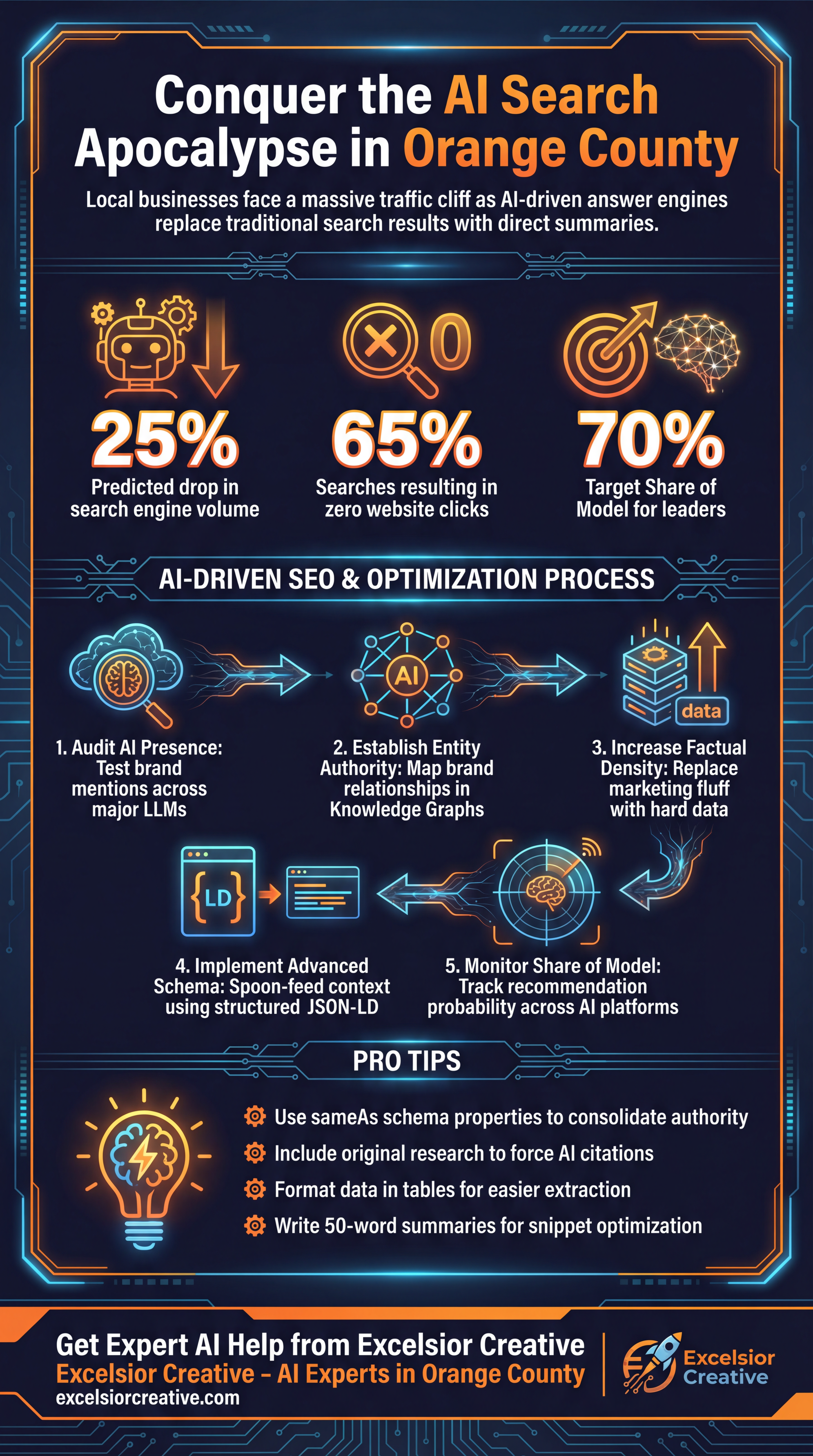
Gartner predicts that search engine volume could drop by 25% by 2026 due to AI chatbots and voice agents, but the immediate threat is the decline in clicks for informational queries. If you run a SaaS company in the OC tech corridor, you likely built your blog traffic on “How-to” guides and educational content. In the past, those queries were top-of-funnel gold. Today, AI Overviews are scraping that content and serving it directly on the results page.
The user gets the value, but your site doesn’t get the visit.
For Orange County’s service sectors, legal, real estate, and medical, the stakes are even higher. If a potential client can get a summarized answer regarding California property tax laws directly from the AI, they’ve one less reason to click through to a local CPA’s website. The traffic simply falls off a cliff before it ever reaches your landing page.
Why Traditional SEO is No Longer Sufficient
This is why the old playbook is failing. Traditional SEO was built on the premise of ranking #1 to capture the click. But in an AI-first world, you can rank #1 organically and still be buried below the fold, hidden under a massive block of AI-generated text.
Optimizing for keywords is becoming less effective because AI doesn’t match keywords; it understands concepts and entities. If your strategy relies solely on backlinks and keyword density, you are optimizing for a version of the internet that’s rapidly disappearing.
The urgency for Orange County businesses to pivot is real. The winners in this new landscape won’t be the ones trying to out-game the algorithm for a blue link. The winners will be the businesses that optimize for inclusion in the AI answer itself, a strategy known as Answer Engine Optimization (AEO). If you aren’t the source the AI trusts to generate its answer, you aren’t just losing traffic; you’re becoming invisible.
Understanding AIO and GEO: The New Digital Frontier

Illustration for AI Optimization Orange County: The Future of AIO & GO
So, if invisibility is the risk, how do we secure that prime real estate inside the answer? If we accept that the goal has shifted from “ranking” to “inclusion,” we need to understand the mechanics of how to get there. This requires mastering two emerging disciplines that sound similar but serve distinct functions: AI Optimization (AIO) and Generative Engine Optimization (GEO).
While traditional SEO was about convincing a search engine that your page was popular, these new strategies are about convincing a Large Language Model (LLM) that your content is true.
what’s AI Optimization (AIO)?
Think of AI Optimization (AIO) as public relations for robots. It is the broad practice of influencing how Large Language Models, specifically giants like Google’s Gemini, OpenAI’s GPT-4, and Anthropic’s Claude, perceive your brand entity.
In the past, Google simply matched the keywords on your website to a user’s query. Today, LLMs operate on probability and association. They don’t just “look up” information; they predict the next most likely word in a sentence based on the vast training data they’ve consumed. AIO is the strategic process of ensuring that when an AI predicts an answer regarding “top commercial real estate firms in Newport Beach,” your company is mathematically associated with that concept.
AIO isn’t just about code; it’s about brand ubiquity and sentiment. It involves seeding the digital ecosystem with consistent, high-quality mentions of your brand across platforms these models trust, news sites, industry journals, and authoritative directories. The goal is to train the model to recognize your business not just as a website, but as a verified entity and a subject matter authority.
Generative Engine Optimization (GEO) Explained
If AIO is the broad strategy of brand association, Generative Engine Optimization (GEO) is the tactical execution of your on-page content.
Recent research into GEO suggests that the way we structure articles for humans often confuses AI models. GEO strategies prioritize factual density. While a human reader might enjoy a long, winding anecdote to set the mood, an AI engine views that as noise. To optimize for Generative Engines (like Google’s AI Overviews or Bing Chat), your content needs to be rich with statistics, direct answers and authoritative citations.
For an Orange County business, this means moving away from fluff and toward hard data. Instead of writing generic paragraphs about “experienced legal help,” a GEO-optimized page would cite specific California civil codes, reference local case outcomes, and use structured data formats that machines can easily parse. The objective is to provide the “source material” that the AI feels compelled to quote to back up its claims.
The Core Differences Between LLM Retrieval and Indexing
To truly implement these strategies, we have to unlearn how we think search engines work. The difference between the old method (Indexing) and the new method (LLM Retrieval) is the difference between a librarian and a research analyst.
The Librarian (Traditional Indexing):
When you used to search for something, Google acted like a librarian. You asked a question and the librarian pointed to a shelf and said, “I haven’t read these books, but this one seems popular and the title matches what you asked for. Go read it yourself.” The librarian’s job was simply to retrieve the link.
The Research Analyst (AI Synthesis):
LLMs act like a research analyst. When you ask a question now, the AI reads the books on the shelf for you. It synthesizes the information, cross-references the facts, and writes you a summary. It doesn’t just point you to a URL; it consumes the content on the URL to generate a new answer.
This distinction is critical. In the retrieval era, you just needed a catchy title and some backlinks to get the librarian to point at you. In the synthesis era, if your content lacks substance, the analyst will read it, realize it adds no value to the summary, and discard it entirely. To win in this new frontier, your content must be the substance the analyst relies on to write their report.
The Orange County Competitive Landscape in the Age of AI

Illustration for AI Optimization Orange County: The Future of AIO & GO
So, if the AI is acting as a “Research Analyst” rather than a librarian, how does that change the game for businesses right here in Orange County?
The shift is seismic. In the past, a business in Anaheim or Laguna Hills could compete simply by having a website that shouted the loudest (via keywords and backlinks). But the Research Analyst doesn’t care who shouts the loudest; it cares who has the most credibility. In a region as economically dense and competitive as Orange County, the AI is constantly sifting through data to distinguish between established local authorities and digital ghosts.
If your business isn’t part of the “source material” the AI uses to learn about the OC market, you aren’t just ranked low, you are effectively invisible.
High-Stakes Verticals: Real Estate, Healthcare, and Professional Services
The impact of this shift isn’t distributed equally. It lands hardest on industries where trust, proximity, and high-value transactions intersect. In Orange County, this trifecta is most visible in real estate, specialized healthcare and professional services (legal and financial).
Consider the behavior of a user asking an LLM (Large Language Model) like ChatGPT or Gemini for a recommendation. They aren’t asking, “List of realtors in Newport Beach.” they’re prompting: “Who is the top luxury real estate agent for waterfront properties in Newport Beach with experience in off-market listings?”
For the AI to answer that, it can’t rely on a generic “About Us” page. It needs third-party validation. It looks for:
- Entity Establishment: Does the AI recognize the agent as a distinct entity in its training data?
- Sentiment Analysis: what’s the consensus of reviews and articles across the web regarding this agent?
- Contextual Expertise: Has this agent been cited in local business journals or industry reports specifically regarding waterfront properties?
If you are a plastic surgeon in Irvine or a wealth manager in Mission Viejo, the AI is judging you against your competitors based on the depth of your digital footprint, not just the optimization of your landing page.
The Local Advantage: Why AI Citations Matter for OC Proximity
This brings us to the concept of hyper-local relevance. One of the biggest criticisms of Generative AI is its tendency toward homogenization, making everything sound the same. However, this weakness is actually a shield for local businesses that know how to use it.
Global brands often struggle to penetrate local markets in AI results because they lack specific, localized training data. An AI might know that a national law firm handles personal injury, but it doesn’t “know” that firm has a 20-year history of winning cases specifically in the Santa Ana court system.
This is where AI Citations become your most valuable asset.
Think of citations as the bibliography for the Research Analyst’s report. When an AI answers a query about “best roofers in Orange County,” it prioritizes businesses that are cited by other trusted local sources, local chambers of commerce, regional news outlets, and specific industry directories. These citations prove to the AI that you are physically present and operationally relevant in the geography of the user. Without them, you are at risk of digital erasure, a state where the AI simply does not know you exist, regardless of how nice your website looks.
Case Study: The Cost of Invisibility in the Irvine and Newport Markets
To visualize the financial impact of this, let’s look at a comparative scenario in the competitive Irvine and Newport Beach legal markets.
Business A (The Traditional SEO Approach):
A family law firm in Irvine spends heavily on Google Ads and traditional SEO. They rank #3 on Google for “Irvine divorce lawyer.” However, they’ve almost no presence in the datasets used to train LLMs (limited press, few directory listings, no semantic authority).
Business B (The AIO Approach):
A competing firm in Newport Beach ranks #8 on Google but has focused on AIO (Artificial Intelligence Optimization). They’re mentioned in local business editorials, have consistent NAP (Name, Address, Phone) data across high-authority directories and publish white papers referenced by other legal sites.
The Result:
When a user asks Google Search, Business A gets the click. But search behavior is migrating. When a user asks an AI, “I need a divorce lawyer in OC who specializes in complex asset division for business owners,” the AI recommends Business B.
Why? Because the AI “read” Business B’s white papers and saw Business B cited in articles about asset division. It synthesized that data and formed a recommendation. Business A, despite its high Google rank, offered no deep “substance” for the Research Analyst to consume, resulting in digital erasure for high-intent queries.
In the Orange County market, where customer lifetime value is high, missing out on that AI recommendation isn’t just a traffic loss; it’s a significant revenue leak.
The Mechanics of AI Citations: How to Get ‘Mentioned’

Illustration for AI Optimization Orange County: The Future of AIO & GO
So, how did that Newport Beach firm pull it off? They didn’t win that recommendation by magic, and they certainly didn’t do it by stuffing the phrase “complex asset division” into their footer fifty times. They won because they understood the fundamental shift in how search engines and now, answer engines, process information.
While Business A was busy playing the numbers game with backlinks and keyword density, Business B was engineering its digital footprint to speak the native language of Large Language Models (LLMs). To replicate their success and secure those high-value AI recommendations, we have to move beyond traditional ranking factors and look under the hood at the mechanics of AI citations.
The Importance of Entity-Based Optimization
For the better part of two decades, SEO was largely about “strings” of text. If you wanted to rank for “best patio furniture in Laguna Niguel,” you made sure that specific string of characters appeared in your H1 tags and body copy.
Generative AI doesn’t care about strings; it cares about “things”, or, in technical terms, Entities.
An entity is a distinct concept understood by the search engine. It could be a person (Elon Musk), a place (Disneyland), or a business (Excelsior Creative). In the modern search landscape, Google and LLMs like ChatGPT use a Knowledge Graph to map the relationships between these entities.
To optimize for this, you must shift your focus from keyword density to entity authority. The AI needs to understand not just what keywords you use, but who you are and what you are related to.
For an Orange County business, this means establishing a clear, unambiguous identity in the Knowledge Graph. If you are a boutique real estate agency, the AI needs to see consistent data connecting your brand entity to related entities like “luxury housing market,” “coastal property,” and specific geographic entities like “Dana Point” or “Corona del Mar.” The goal is to build enough confidence in the AI’s logic that it views your brand as the definitive authority on a specific topic within a specific region.
Building Authoritative Digital PR for AI Training Data
Once the AI understands who you are, the next hurdle is convincing it that you matter. This is where the concept of “citations” changes dramatically.
In traditional SEO, a link from a random blog might pass some “link juice.” In AIO (Artificial Intelligence Optimization), the source of the information is critical because LLMs are trained on specific, high-quality datasets. They don’t just crawl the web indiscriminately; they prioritize “seed sets” of trusted data, think Wikipedia, major news outlets, academic journals, and established industry publications.
To get mentioned by an AI, your brand needs to appear in the text that the AI “reads” to learn about the world. This requires a Digital PR strategy focused on securing mentions in high-authority datasets.
For example, a press release distributed to a generic newswire might get you a temporary Yahoo! Finance link, but it rarely becomes part of an LLM’s long-term memory. However, a feature article in the Orange County Register, a guest column in a respected industry trade journal, or a white paper cited by a.gov or.edu domain? that’s gold.
When an LLM scans these high-authority sources and sees your brand repeatedly associated with “innovative logistics” or “medical malpractice expertise,” it encodes that association. Later, when a user prompts the AI for a recommendation, the model recalls that synthesis. You aren’t just a search result; you are part of the training data itself.
Structured Data and Schema: The Language of Machines
If Entity Optimization is the “who” and Digital PR is the “where,” then Structured Data is the “how.”
Generative engines are incredibly smart, but they can still hallucinate or get confused by ambiguity. You never want to leave the AI guessing about your business details. Structured data, specifically Schema markup, is how we spoon-feed context to the machine in a format it perfectly understands (JSON-LD).
Think of Schema as the metadata tag on a library book. Without it, the AI has to read the whole book to figure out the genre. With it, the AI knows immediately: This is a LocalBusiness. It serves Orange County. It has a rating of 4.9. It specializes in these specific services.
For AIO, we need to go beyond the basics. We use advanced Schema types to solidify your authority:
- `sameAs` properties: This tells the AI, “This website, this LinkedIn profile, and this Crunchbase listing are all the same entity.” It consolidates your authority.
- `hasCredential`: For professional services (like our legal example), explicitly marking up awards, degrees, and certifications validates expertise.
- `mentions`: You can even use markup to tell the AI that your content is about a specific topic entity, linking your article to the Wikipedia page for that topic.
By using this code, you are effectively speaking directly to the crawler. You are removing the guesswork. When an AI is formulating an answer and needs to verify a fact, like your service area or your pricing structure, it will favor the source that provides that data in clear, structured code over a source that buries it in paragraphs of marketing fluff.
In the competitive Orange County market, this technical clarity is often the tie-breaker that moves a brand from “unknown” to “highly recommended.”
Content Strategy for the Post-Click Era
Additional infographic for AI Optimization Orange County: The Future of AIO & GO
While Schema markup provides the structural blueprint, the skeleton, of your digital presence, the actual text on your page is the muscle. You can have the most pristine JSON-LD code in Orange County, but if the content itself is thin, generic, or derivative, AI models will bypass it in favor of sources that offer substance. We’re entering the “Post-Click Era.” Users are increasingly satisfied with the answer provided directly by the AI or the search engine results page (SERP) snapshot. They aren’t clicking through to your blog to read a 2,000-word intro about the history of the printing press; they want the answer, and they want it now. As a result, our strategy must shift from creating content designed to lure clicks to creating content designed to be cited as the primary source of truth.
Factual Density vs. Fluff: Writing for LLM Extraction
For the last decade, SEO content often fell into the trap of “fluff”, lengthy, repetitive prose designed to hit word count targets and house keywords. Large Language Models (LLMs) like GPT-4 and Gemini are notoriously efficient at ignoring this. They crave Information Gain and Factual Density.
To optimize for AIO, we need to stop writing content that merely describes a topic and start writing content that defines it. This means your site needs to act less like a brochure and more like a database.
- Be the Statistic: Instead of saying “We handle many divorce cases in Irvine,” say “We have successfully mediated over 400 divorce cases in the Irvine and Newport Beach jurisdictions since 2020.”
- Structure for Extraction: AI models love structure. Use bullet points, comparison tables and distinct “Key Takeaway” summaries. If an AI is scraping the web to answer “what’s the cost of commercial solar in Anaheim?”, it will prioritize a page that offers a clear pricing table over a page that buries the numbers in a dense paragraph.
- Original Data: The highest value signal you can send an AI is original research. Surveys, case studies and proprietary data sets are gold. If you are the only source of a specific data point, the AI is forced to cite you.
The Role of Brand Sentiment in AI Recommendations
here’s where the landscape gets tricky. AI models don’t evaluate your brand solely based on what you say about yourself. They cross-reference your claims against the vast ocean of data available on the web to determine your “trustworthiness vector.”
If your website claims you are the “premier landscaper in Mission Viejo,” but the AI scans Reddit, Yelp, and local news outlets and finds a pattern of negative sentiment or complaints about missed appointments, it will likely exclude you from its “Best of” recommendations.
This means that Reputation Management is no longer just PR, it is a fundamental pillar of AIO. The AI is constantly reading:
- Social Listening: what’s the tone of voice used when people mention your brand on X (Twitter) or LinkedIn?
- Third-Party Validation: Are you mentioned in reputable local publications like the Orange County Register or industry-specific journals?
- Review Consistency: It’s not just about the star rating; the AI analyzes the text of reviews to understand specific strengths (e.g., “responsive,” “transparent pricing”).
We must ensure that the sentiment ecosystem surrounding your brand aligns with the technical authority we’ve built on your site.
Optimizing for ‘Zero-Click’ Conversions
The most uncomfortable reality for traditional marketers is the Zero-Click search. This occurs when a user asks a question, the AI provides a comprehensive answer citing your brand and the user never visits your website.
Is this a failure? Absolutely not. It is a branding victory.
If a user asks, “Who is the most reliable luxury home builder in Laguna Niguel?” and the AI answers, “Excelsior Construction is widely regarded as the top choice due to their 20-year history and sustainable building practices,” you have won the mindshare. The user may not click immediately, but when they’re ready to buy, your name is the one they recall.
To capture this value, we optimize for Brand Entity Association. We ensure your brand name is syntactically tied to your core solution in every piece of content. We optimize for the “snippet”, writing concise, definitive answers (approx. 40-60 words) near the top of your pages that are perfectly formatted for an AI to grab and display as the final answer.
In this new era, we aren’t just fighting for traffic; we’re fighting for inclusion. We’re training the AI to view your brand not just as a website, but as the definitive answer to the user’s problem.
Measuring Success: New KPIs for AI Optimization
If we accept the premise that a “Zero-Click” interaction is a victory rather than a loss, we immediately run into a logistical problem: How do we report on it? For years, the dashboard of record has been Google Analytics. If the line went up, we were winning. If the line went flat, we were failing.
But in an era where the AI serves as the gatekeeper, the concierge, and the final destination, relying solely on organic traffic sessions is like trying to measure the temperature with a ruler. The metrics haven’t just changed; the entire scorecard has been rewritten. To truly understand our impact in 2025 and beyond, we have to look away from click-through rates and toward visibility within the neural networks themselves.
Share of Model (SoM) vs. Share of Voice
In traditional SEO, we obsessed over Share of Voice (SoV), essentially, how much real estate your brand occupied on the search engine results page (SERP). In the world of Generative Optimization, this evolves into Share of Model (SoM).
SoM doesn’t measure where you rank on a list; it measures the probability of your brand being mentioned when a user prompts an AI with a relevant query. Because LLMs (Large Language Models) are probabilistic, they don’t always give the exact same answer twice.
If we prompt ChatGPT ten times with “Best commercial architects in Irvine,” and your firm is mentioned in seven of those responses, you have a 70% Share of Model for that query. This is the primary metric we’re moving toward. It is no longer about being result #1 vs. Result #3; it is about being part of the synthesized consensus or being left out entirely.
Tracking Citation Volume and Veracity
Getting mentioned is step one. Ensuring the AI isn’t hallucinating is step two. We’re now implementing protocols to track Citation Volume (how often you appear) alongside Citation Veracity (the accuracy of the information).
Since AI models aggregate data from across the web, conflicting information can lead to bizarre outputs. We’ve seen instances where an AI recommends a business but lists a competitor’s phone number or describes services the business stopped offering five years ago.
Monitoring this requires a mix of manual auditing and emerging AIO tools that scrape AI responses. We look for the “sentiment ecosystem” mentioned earlier. Are the citations linking your brand to the correct entities (e.g., “Excelsior” + “Creative Strategy” + “Orange County”)? If the volume is high but the veracity is low, we have a data hygiene problem to fix on your site and third-party directories.
Attribution Challenges in a Generative World
here’s the most difficult pill for data-driven marketers to swallow: The “Dark Funnel” is getting darker.
When a user reads about your brand in a Gemini or ChatGPT summary, they rarely click a citation link. Instead, they digest the recommendation, close the tab, and later type your brand name directly into their browser. In GA4, this shows up as “Direct Traffic” or “Branded Search.”
So, we can no longer view organic non-branded traffic as the sole indicator of SEO health. We must adapt our analytics to look for correlations. When we execute an AIO campaign targeting “luxury home builders,” do we see a corresponding lift in branded search volume two weeks later?
Success in this new landscape means accepting that the path to conversion is non-linear. We’re optimizing for influence, trusting that when we win the argument inside the AI, the revenue follows.
Implementation: An AI Optimization Roadmap for OC Businesses
Understanding that influence drives revenue is one thing; engineering that influence is another. Since we can’t rely on traditional click-through rates to tell us if we’re winning, we have to rely on the quality of the data we feed the machines.
If you are ready to move from passive observation to active management of your brand’s AI narrative, here’s the roadmap to get there.
Immediate Steps to Audit Your AI Presence
Before you spend a dime on new tech, you need to know what the models currently think of you. We recommend conducting a “blind test” of your brand.
Open three tabs: ChatGPT (OpenAI), Claude (Anthropic), and Gemini (Google). Act like a prospective client who has never heard of your company but needs your specific services.
Ask prompts like:
- “Who are the top commercial architects in Irvine?”
- “Compare [Your Brand] vs. [Competitor Brand] for enterprise software development.”
- “Is [Your Brand] reliable?”
Document the results. Are the answers accurate? Is the AI hallucinating services you don’t provide? Is it pulling a phone number from an old office location in Anaheim that you closed three years ago?
This manual audit usually reveals the low-hanging fruit. If the AI doesn’t know who you are, or worse, thinks you are someone else, your immediate priority is data consistency across the web, updating your “About” page, Wikipedia entries (if applicable), and major business directories to ensure a unified “entity identity.”
Long-term Investment in Information Architecture
While a content audit fixes immediate errors, long-term success requires a structural overhaul of how you present information. Large Language Models (LLMs) crave structure. They don’t read websites like humans do; they ingest them as data points.
This means your website’s Information Architecture (IA) must be impeccable. We aren’t just talking about a clean navigation bar. We’re talking about Schema markup, structured data, and semantic HTML that explicitly tells the crawler, “This is a service, this is the location, and this is the price range.”
This is where partnering with local AI optimization experts in Orange County becomes vital. A generic agency might optimize for global keywords, but a local partner understands the semantic nuances of the OC market, how “South County” implies a different demographic than “Santa Ana,” and how to code those geographic relationships so the AI understands your true service area.
Conclusion: Securing Your Place in the Future of Answer Engines
we’re witnessing a fundamental shift in human behavior. We’re moving from an era of finding, where users hunt through ten blue links to assemble the truth, to an era of answering, where the machine synthesizes the truth for them.
If your business isn’t part of that synthesis, you are invisible.
The “Dark Funnel” may be difficult to track, but it isn’t impossible to influence. By auditing your current standing, cleaning up your data ecosystem and structuring your content for machines as well as humans, you ensure your brand remains the recommended choice.
At Excelsior Creative, we help forward-thinking businesses navigate this transition. We don’t just write content; we architect information that Answer Engines trust.
Ready to control the conversation about your brand? Contact Excelsior Creative today and let’s build your AI optimization strategy.